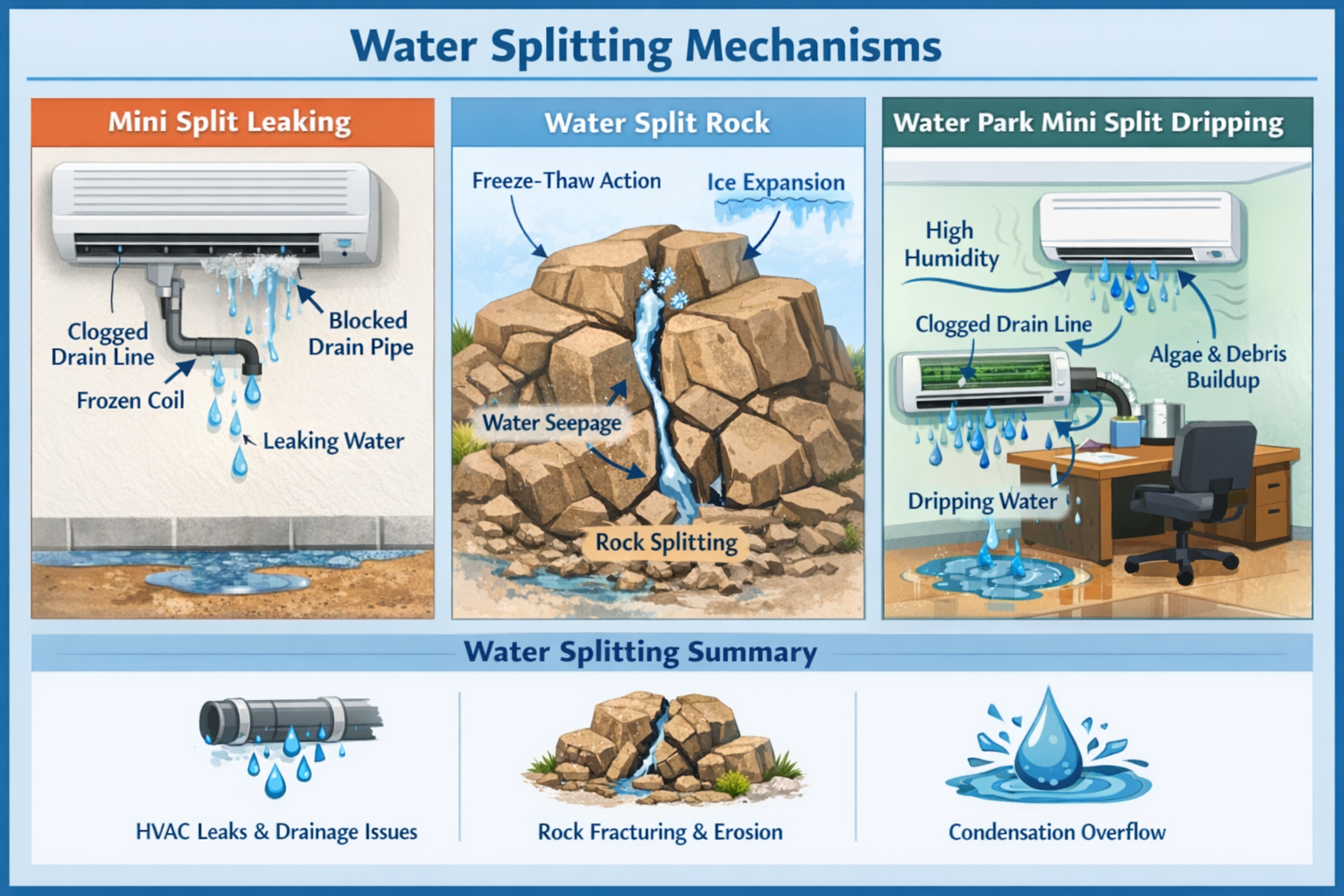
Wastewater splitting and water splitting are important concepts in environmental science, engineering, and everyday infrastructure. At a technical level, water splitting refers to the separation of water into its components or the controlled movement of water through systems. In practical settings, however, “water splitting” is often used informally to describe unintended water separation or leakage caused by pressure, blockage, or system failure.
From household HVAC systems to outdoor recreational facilities and even natural rock formations, water splitting can appear in many forms. Understanding why and how water separates or leaks helps prevent damage, conserve water, and improve system efficiency.
Mini Split Leaking
A mini split system is a ductless air conditioning and heating unit that relies on condensation to remove humidity from the air. During normal operation, moisture collects on the evaporator coil and drains away through a condensate line. When this process fails, water begins to leak.
Common causes of a mini split leaking include:
- A clogged or blocked condensate drain line
- Improper installation or poor unit leveling
- Dirty air filters causing ice buildup and melting
- Cracked or disconnected drain pipes
In essence, this is a form of uncontrolled water splitting, where water separates from the system and escapes into surrounding areas instead of flowing through its designed drainage path.
Water Split Rock
Water split rock refers to a natural process where water penetrates cracks in rocks and expands due to freezing, pressure, or mineral growth. Over time, this causes rocks to split apart. This geological water splitting process plays a major role in erosion and landscape formation.
Key factors behind water split rock include:
- Freeze–thaw cycles
- Continuous water seepage into rock fractures
- Pressure from expanding ice or mineral deposits
This natural form of water splitting demonstrates how even small amounts of water, when repeatedly trapped and expanded, can cause significant structural changes.
Water Park Mini Split Dripping Water
In water parks, mini split systems are often used in offices, control rooms, and indoor attractions. Due to high humidity levels, these systems produce more condensation than standard residential units. When drainage is insufficient, dripping water becomes a common problem.
Reasons a water park mini split may drip water include:
- Excessive humidity overwhelming the drainage system
- Algae or debris buildup in drain lines
- Inadequate maintenance schedules
- Incorrect system sizing for high-moisture environments
Here, water splitting occurs as condensation separates rapidly from humid air and overwhelms the system’s ability to manage it properly.
Why Is My Mini Split Leaking Water
If you’re asking, “Why is my mini split leaking water?” the answer usually lies in maintenance or installation issues. While some condensation is normal, visible leaks are not.
Typical reasons include:
- Blocked drain line preventing proper water flow
- Frozen evaporator coils due to low refrigerant or airflow issues
- Loose drain pan connections
- Long periods without professional servicing
Addressing these issues early prevents water damage, mold growth, and reduced system performance. Proper drainage ensures water remains controlled rather than splitting off into unwanted areas.
Conclusion
Water splitting, whether in wastewater systems, geological formations, or HVAC equipment, is a powerful and often underestimated process. While controlled water separation is essential for system efficiency, uncontrolled water splitting leads to leaks, structural damage, and costly repairs.
By understanding how and why water separates—especially in mini split systems—you can take preventive measures, maintain equipment properly, and ensure water flows exactly where it is intended to go.
you may also read: Smart Composite Photocatalysis for Green Technologies